


The suitcase is finally in the hallway, the photos look lovely, and the tan is still hanging on. By all available evidence, you have just come back from holiday and should now feel, if not like a completely new person, then at least like a noticeably fresher edition of yourself.
There is just one small inconsistency: your internal battery is showing 12%.
This becomes especially obvious on the first morning back at work. The alarm is more offensive than usual, getting out of bed feels like a multi-stage extraction process, coffee impersonates alertness for a while, and you reread a two-line email with the concentration normally reserved for a contract to buy an oil rig.
Somewhere between a colleague’s first “good morning” and your tenth unread email, a perfectly reasonable question occurs to you: “I’ve just had a holiday. Why do I feel completely wiped out?”
It feels particularly unfair. You were officially on holiday. So where are the promised freshness, clear head and urge to move mountains at work? At the moment, even a modest hill feels unnecessarily ambitious.
If this sounds familiar, there is nothing unusual about it. We tend to treat holidays and recovery as almost the same thing, although in practice they are not always remotely identical.
Travel can drain the battery too
We usually think of holidays as the opposite of work: if there have been no meetings, deadlines or work chats for a couple of weeks, surely the body must have spent all that time quietly stockpiling energy.
But sometimes a holiday is simply one project replacing another. Excel disappears; in its place come a suitcase, satnav, tickets, an unfamiliar city and the daily strategic question of where exactly everyone is going to eat tonight.
Before the trip, you have to pack and attempt not to forget anything important. Then you have to get there, find your bearings, adjust to a different bed, different food and a different routine. If you are travelling with family, other people’s wishes and plans join the itinerary, along with the ongoing negotiations about where to go, when to come back and why, on this particular day, everyone has suddenly decided they want completely different things.
Even enjoyable experiences use energy. New places, excursions, long walks, late dinners, flights and an unfamiliar routine may all be wonderful, but the body does not keep separate accounts labelled “pleasant exertion” and “unpleasant exertion”. As far as it is concerned, exertion is still exertion.
So by the end of a busy holiday you may discover a curious paradox: emotionally, you are delighted with the trip, you have enough photographs to last until next summer, and yet your physical energy somehow failed to come home with the luggage.
Coming home somehow doesn’t count as a holiday either
And the adventure usually does not end there. Technically, you are home, but the suitcase will not unpack itself, the fridge cannot be restocked by positive thinking, the laundry refuses to walk to the washing machine, and the dozen small jobs you postponed before leaving have been patiently awaiting your return.
That often leaves one evening between “we’re finally home” and “back to work tomorrow” — an evening that is somehow expected to accommodate household chores, rest and a complete restoration of your normal routine.
Your body is still mentally somewhere else. Your calendar is very much here.
Only a few days ago, the most urgent decision may have been whether to go to the beach now or after lunch. Now there are dozens of emails, several tasks marked “urgent”, missed calls and a colleague who appears convinced that after two weeks away you will understand everything that has happened within the first three seconds.
You go from a rhythm in which much of the day belonged to you straight into a dense sequence of “reply — check — decide — approve — don’t forget”. And it is often the suddenness of that transition, rather than the work itself, that feels hardest.
On paper, you are already back from holiday. Your body, apparently, has not signed the paperwork yet.
Why even familiar work suddenly takes more energy
Before the holiday, the working day was a familiar system. You knew almost automatically where to start, what mattered most, what could wait and where to find the information you needed.
After a break, that internal map can become temporarily less clear. The amount of work may be almost the same, but even familiar tasks require more attention: you have to reconstruct the context, work through accumulated messages, remember chains of decisions and reset your priorities.
Each of these things uses a little extra energy. Individually, it is barely noticeable. By lunchtime, however, it can feel as though you have already done a full shift.
Then another rather unhelpful trap appears: we start comparing today’s speed with our normal one.
I used to get twice as much done in an hour. Why is it so hard to concentrate now? What on earth has happened to me? Have I completely lost the ability to work after two weeks off?
The natural reaction is to try to “get back up to speed” as quickly as possible. On the very first day, we attempt to clear every email, resolve everything that accumulated, answer colleagues at the same time and catch up on everything that happened while we were away.
A couple of hours later, attention is bouncing between open tabs, messages and tasks, and instead of the long-awaited feeling of control, there is simply more fatigue.
This is often when coffee joins the operation. The first cup may genuinely help a little. Then comes the second. By the third, coffee is sometimes providing more emotional support than actual energy. The tiredness has not gone anywhere; for a while, it has merely lowered its voice.
Add the return to screens, notifications, calls and constant attention-switching, and it becomes easier to understand why the first few working days after a holiday can feel unexpectedly heavy.
And if you also start criticising yourself for not being productive enough, the body receives a delightful little bonus: it is not only tired, it now feels guilty about being tired as well.
Maybe you don’t need another plan
Of course, the basics of recovery still matter. Proper sleep, water, walking and a gradual return to your usual workload are genuinely important.
But when energy is already low, the last thing most people want is to turn recovery into another project.
Advice has a habit of becoming a programme very quickly: monitor your sleep, move more, manage your workload properly, take breaks, learn new practices and remember to do all of them regularly. Every point makes sense on its own. Put them together, though, and one thought may rise above all the others: “Could I just lie down for a bit first?”
This is where a different kind of support becomes interesting — something that does not require another habit, a training course or a special slot in your diary.
Ideally, it would belong to the category of tools best described as: “I carry on with my life, and it simply stays with me.”
You can work, run errands or get things done at home. You can even lie on the sofa and recover from your holiday with great determination. There is no need to march to the coffee machine, press a button and hope that espresso number four will finally return your former self to civilisation.
For people who are short on energy and have absolutely no desire to obtain that energy through yet another effort, it may be worth getting acquainted with FSCs — Functional State Correctors.
What kind of device is this? Why does it not need charging, setting up or deliberately switching on? And how can it be used in ordinary life? That is what we will look at next.
A device you don’t have to switch on
Let us start with perhaps the strangest part: an FSC really does not have an on/off button.
In fact, it has no buttons at all. No screen, battery, wires, ports or need to synchronise anything with your smartphone. At a time when even a toothbrush is trying to connect to an app and send you a performance report, an FSC is almost provocatively independent.
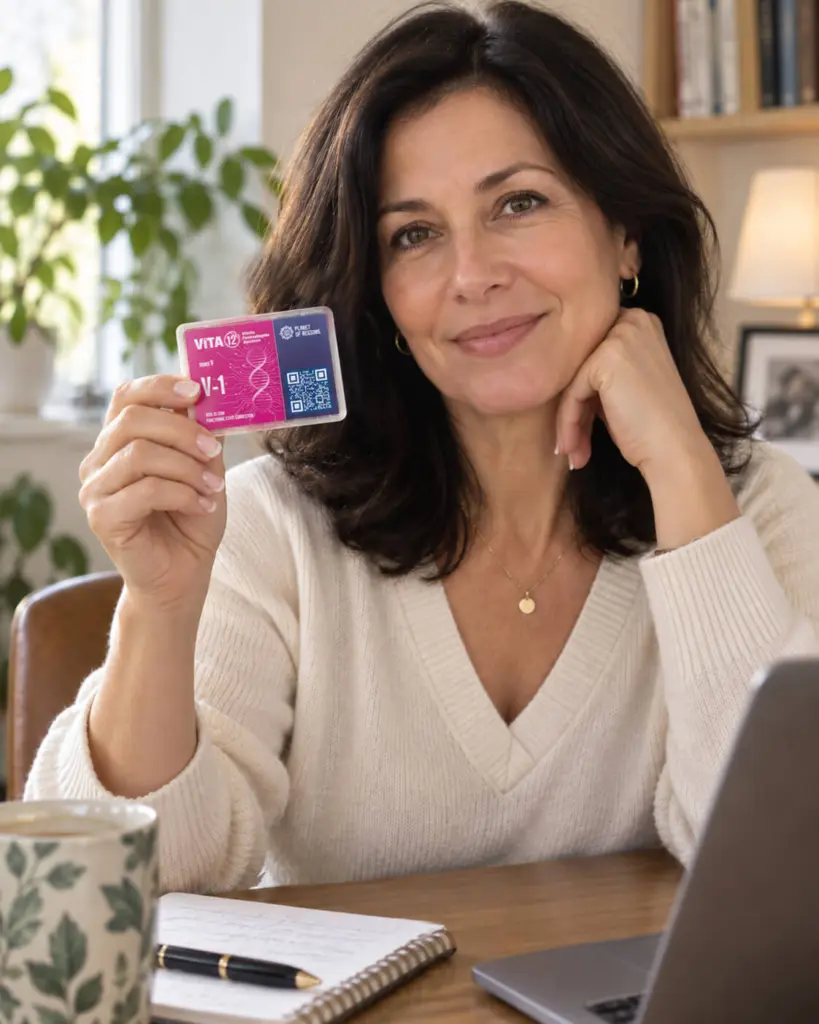
Most FSCs look like small, flat plates with a modern design and softly rounded edges. They sit comfortably in the palm of your hand, feel pleasant to hold and, as some of our customers admit, are oddly satisfying to pick up and touch.
Which naturally raises a question: if there is no familiar electronics inside and the device does not even need to be switched on, what exactly is supposed to happen?
For a moment, we need to venture into the physics of information-wave processes — the territory of scalar waves, torsion fields and a few other concepts that do not normally appear in everyday conversation. Don’t worry: there will be no equations, and nobody is asking you to establish a Department of Modern Physics in your living room.
We are used to devices whose effect is easy to notice: a hairdryer blows air, a kettle heats water, a massager vibrates, and a phone lights up and asks for the password you have once again forgotten.
An FSC belongs to a very different concept.
The elements of an FSC interact with surrounding electromagnetic radiation and transform it into a scalar-wave form. The device itself is not a source of additional energy; its main function is to work with the informational component.
Information spectra from various natural objects — minerals, plants, natural springs and other natural systems — are recorded onto the FSC elements. The resulting field carries this information and interacts with the body’s information-field processes.
In other words, an FSC does not “recharge” a person like a battery. It transmits a particular informational structure that is used by the body in interaction with its own field.
By this point, we have probably thrown scalar waves, information spectra and field interactions at you with the generosity of someone who has accidentally opened a physics textbook on entirely the wrong page. So let us put it in much simpler terms.
Put as simply as possible, an FSC does not act on the body mechanically and is not a source of additional energy. It carries specific information that interacts with a person’s biofield — what everyday language often calls the aura. This interaction supports natural self-regulation mechanisms and contribute to positive changes in a person’s energetic state, which can then be reflected in how they feel emotionally, mentally and physically.
But to be honest, after a holiday, most people are not particularly interested in a scalar wave for its own sake.
They want something else.
They want their brain to come back online.
They want a three-sentence email to stop taking twenty minutes.
They want the sound of an incoming message not to trigger irritation on contact.
And they would quite like to reach the middle of the day with at least a little energy left not just for work, but for their own life.
This is where FSCs become considerably more interesting than the technology behind them.
Not Waves, but a State
The phrase “I have no energy after my holiday” may sound the same from one person to another, but it can describe very different experiences.
One person genuinely feels physically sluggish: getting up is difficult, tiredness comes quickly, and there is a constant urge to sit down, lie down or at least present a convincing case for why today’s work absolutely must be performed horizontally.
Someone else’s body appears to have returned, but their brain has not. They open a document, find themselves in their inbox a minute later, check their phone for no obvious reason, return to the document and spend a while trying to remember why they opened it in the first place.
A third person is perfectly capable of working, but every extra demand causes irritation. Calls are annoying, colleagues are annoying, messages are annoying, and the printer that has chosen this exact day to stop printing begins to feel less like office equipment and more like a personal enemy.
And someone else comes home from a long-distance trip with their sleep schedule scrambled and spends several days living in a mysterious time zone that may not even exist on any map.
So the task is not simply to “find an FSC for after a holiday”. It helps first to work out what you are actually missing right now: physical energy, inner calm, concentration, adaptation to your normal rhythm, or a combination of several states at once.
Once that is clear, you can choose a specific model to match the need.
When you just want your energy back
If the main problem after a holiday is sluggishness, your energy is already running low by the middle of the day and your usual rhythm refuses to return, you can look at FSCs designed to support energy, tone and a more resourced state — for example, FSC «Indi» or FSC «Relaxium»
This is for the situation where you are not so much anxious about returning to work as wondering whether, along with your suitcase, you somehow brought home an extra bag of exhaustion.
When you have energy, but other people are already becoming slightly exhausting
Sometimes the problem is quite different. Technically, you have energy, but the abrupt switch from the freedom of a holiday to calls, tasks, deadlines and other people’s demands creates inner tension and irritability.
For this kind of request, the range includes models focused primarily on emotional state and maintaining inner balance, including ViTA N-4 or FSC «Relaxium».
When your brain is still somewhere on the beach
Concentration is a separate story.
You are sitting in front of the computer. You are even looking at the correct document. Unfortunately, your thoughts keep leaving the workplace without giving notice.
For tasks involving concentration, high intellectual load and long periods of screen work, we recommend looking at FSC «ViTA N-1» or FSC No.13 «Healthy mind»
When you’ve flown home but your body clock hasn’t
If your holiday involved long-haul flights, changes of time zone and disruption to your normal sleep routine, the range includes a dedicated model — FSC-Bracelet «Free way» , recommended to support adaptation to the rhythms of a new time zone.
Because sometimes the problem is not a lack of work discipline at all. Your passport has crossed the border, your suitcase has appeared on the baggage carousel, but your internal clock remains absolutely convinced that it is four in the morning.
We began with someone who already has very little energy after a holiday. It would therefore be slightly cruel to recommend a tool that requires a forty-minute daily practice, special preparation and a separate calendar just to keep track of the results.
One of the practical advantages of FSCs is that they do not require separate time, special actions or changes to your normal routine. A plate can be carried with you or kept nearby, while those who prefer a “put it on and forget about it” format can choose bracelet models. You can work, run errands, answer emails, talk to colleagues or get on with things at home — the FSC stays with you, with no separate wearing ritual required.
And yes, if today’s recovery plan consists of a sofa and a firm decision to avoid unnecessary movement for a while, an FSC will not ask you to cancel the sofa.You do not even have to walk to the coffee machine for it.
The plates can also be used for structuring water, but that is a separate subject we will return to another time.
It is quite an unusual combination: an unconventional technology in an extremely simple format.
No charging. No apps. No “oh no, I forgot to do the practice again”.
Just a tool that can stay with you while life carries on as usual.
350 models — why so many?
FSCs have another feature that can initially look more like a problem: there are more than 350 models.
For someone who struggled with their inbox five minutes ago, the prospect of independently researching another 350 plates is unlikely to produce an immediate surge of enthusiasm.
But there are so many models precisely because people’s needs are different.
One person may need energy most. Another wants calm. A third needs concentration. Someone else has managed to collect fatigue, irritability and a brain that is flatly refusing to return from holiday all at the same time.
That is why it makes more sense not to choose an FSC on the basis of “which plate looks nicest”, and not to search for one model that somehow answers every possible need equally well.
A much simpler place to start is with one question: “What state am I missing most right now?”
From there, you can explore specific FSC models. If you enjoy researching things yourself, open the catalogue, read the descriptions and gradually explore this rather large world. Many FSCs have several areas of action, so choosing is not always as simple as “fatigue — one model, concentration — another”.
If you would rather not turn choosing an FSC into a research project of its own, you can write directly to a specialist. Simply describe how you feel, what you seem to be missing and what is bothering you most, and the specialist can suggest several models worth looking at.
If, before choosing, you would simply like to understand what FSCs are, how they are designed, what types exist and how they are used, start with the “Introduction to the World of FSCs” page. It brings together the key materials so you can get to know the system at your own pace and decide what you would like to explore further.
After all, you already have enough to do after a holiday. Working through 350 options on your own is entirely optional.